THINKING OUTSIDE THE MASS
FRACTION BOX
Part 1: NASA’s Lunar Architecture Design Goals are Good,
but not quite what we need to Maximize our Lunar Presence Investment
By Peter Kokh
Moon Society Advisor and Videographer
Chip Prose had asked me to define the steps we need to take to realize
a human presence on the Moon to support a full buildout of an
Earth-Moon Economy. Actually, we have talked about most of the elements
and steps needed in various articles in MMM through the years. Part 1: NASA’s Lunar Architecture Design Goals are Good,
but not quite what we need to Maximize our Lunar Presence Investment
By Peter Kokh
Thinking within the “Mass Fraction” Box guarantees failure
But it is a very worthwhile endeavor to do the exercise afresh, and with deliberation. We’ll make a start with this article, laying out basic concepts to “really maximize” the payload delivered to the Moon. This means throwing out the window of the slavishly worshiped law of “the mass fraction.”
According to Wikipedia, “In aerospace engineering, the mass fraction is a measure of a vehicle's performance, determined as the portion of the vehicle's mass which does not reach the destination. ... In rockets for a given target orbit, a rocket's mass fraction is the portion of the rocket's pre-launch mass (fully fueled) that does not reach orbit. ... typically around 0.8 to 0.9 [80-90% of the takeoff mass does not reach orbit]” The figure is even more discouraging when we are considering the typical mass fraction deliverable to the lunar surface.

The huge Saturn 5 in comparison to its tiny cargo, the lunar excursion module
- minimize ascent module mass
- minimize descent module mass
- maximize landed “payload” mass
- simplify interfaces
- move functions across interfaces when it makes sense
Thinking outside the “Mass Fraction” Box, Part 1
When you think of it, the payload “landed to remain on the Moon” in the Apollo missions consisted only of the descent stage, and assorted equipment left behind. Not much! NASA’s new “space-motorcycle”-inspired plan will allow leaving the spacious crew cabin behind. That’s a big step, but still within the “Mass Fraction Box.”
Our first article on “Thinking outside the “Mass Fraction Box” was “Essays in ‘M’: Marshall MacLuhan: “Medium is the Message” in MMM #6, June 1987. This is republished in MMM Classic #1 - download from:
www.moonsociety.org/publications/mmm_classics/
In this article, we pointed out that the most common flaw in thinking within the “mass fraction box” was to assume without question that no part of the vehicle itself could be reassigned as “payload.” We illustrate the possibilities by offering an alternate configuration for the Space Shuttle Orbiter. I urge you to download that volume cited above, if only to get this point across.
Here we are talking about delivery to the lunar surface. In that context, our quest to cheat the “mass fraction” rules drives us to make sure that everything that we have paid precious fuel to land on the Moon, and which will not depart on the ascent vehicle, is something that has more than temporary usefulness: that includes every part of the landing platform mass:
- fuel tanks & descent engine & • vernier rockets
- cargo hold & • unloading equipment
- leg struts & • foot pads, • etc.
- The item can be reused as is. For example, the bulk of the descent platform, minus engines and fuel tanks, might be reused as a platform for a telescope
- The item’s design could be tweaked to enable it to serve some different application, whether similar or quite different, for example, landing struts could be assembled in line to use as an antenna mast, or alternatively to serve as part of a space frame for a canopy shed
- Perhaps part of the descent stage equipment could be designed as a mobile chassis for the crew cabin, either to taxi the cabin to its installation site, or to turn the cabin into a pressurized lunar surface bus.
- The item could be forged of a material that would be invaluable on the Moon, such as lead, copper, brass, or stainless steel; some components, for example shipping stuffs, could be made of reusable plastics, or compressed biodegradables rich in nutrients scarce in lunar regolith
We would be delighted to see the NASA Moon Lander Office adopt these design goals also. This is not a new philosophy. Poor people are known to use all parts of a slaughtered pig “except the squeal!” NASA should and must adopt a “we are poor” posture, in the sense that the agency will never get all the money it might want and must learn to make do with what it gets. And to do that successfully, means not to cut this and that, that’s a petulant knee jerk reaction, but to exercise maximum resourcefulness. Use everything twice!
Note that our title reads: “Thinking outside the “Mass Fraction” Box, Part 1” We hinted in our reference to the article from MMM #6, that the launch vehicle itself, and every stage of it, can be redesigned to add more to what lands on the Moon and contributes to the buildup of the lunar outpost/settlement.
PART 2: Improving on NASA’s Lunar Architecture Design Goals
In the first installment last month, Part 1, we talked about making maximum use of everything landed on the Moon. That way everything we land on the Moon becomes payload delivered, not just the crew and cargo. Let’s carry the argument further.
The Translunar Injection Stage as a Deliverable
Any part of the Earth Orbit <> Lunar Orbit ferry vehicle that delivers the landing craft to low lunar orbit for its descent to the Moon’s surface, which is not needed for the return to Earth orbit can be delivered the rest of the way to the lunar surface at little extra cost. What things this may consist of depends on the vehicle’s design. Expended fuel tanks (unless they are refueled with lunar liquid oxygen) and farings are two obvious suggestions. Of course, this implies that these items can be replaced in LEO for the next trip out to the Moon.
In Apollo, the Saturn 3rd stage that brought the LEM and Apollo Command Module was effectively tossed overboard, left to crash on the Moon. (area in dotted box)
3rd Stage thrown away with enough momentum to make it to the vicinity of the Moon
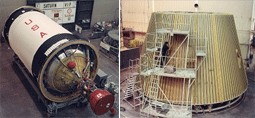
---Saturn SIVB left -- ---SIVB Adapter Skirt right
http://en.wikipedia.org/wiki/Saturn_V#S-IVB_third_stage
The SIVB: 58’ 7“ [17.85m] tall/long; 21’ 8” [6.6m] wide, such a volume landed could provide ample storage, or, set on its side, a spacious 2-floor habitat module. The adapter skirt covered the SIVB engine and mated the SIVB to the Saturn 2nd stage. This could be saved also.
Yes, to deliver this stage the rest of the way to a soft landing on the Moon requires more fuel, but at least the oxygen required could be brought up from the lunar surface. Delivered, this adds large fuel tanks which could be put to welcome use in the moonbase, plus an engine, cannibalizable wiring and other components. Remember, we already paid the freight to get it almost all the way!
Those with shortsighted vision would not want to bother, but if you are a prospective lunar pioneer, not to take advantage of such a golden opportunity would be unforgivable, and as lunar frontier history may someday judge, forever listed as an act of unthinking treason against the future Lunar Republic.
We are not suggesting that the Lunar Module ride to the surface atop this 3rd stage, though if we decided to do that, the weight savings involved in not needing to equip the Lunar module with its own separate descent stage engines and tanks, might go a good ways toward paying for the extra fuel.
The equivalent of the Apollo Command Module needed to return crew to Earth orbit or to Earth directly, could be dropped off en route, breaking into lunar orbit, while the 3rd stage with lunar module and minimalized ascent stage continued directly to the lunar surface. It’s a different lunar architecture but the potential payoff in “total payload delivered” is too great not to pursue. As we work out the design and trade off particulars, a show-stopper problem may emerge, but with the right attitude, we can bet that a doable workaround will be found.
In the scenario above, even the farings that protected the lunar lander on its trip up through Earth’s atmosphere, could make the trip all the way. They would surely be useful for one thing or another.
A Proper Guiding “Philosophy” is essential
We must always keep in mind that maximum total payload mass delivered is the Holy Grail. That implies, of course, that we have predesigned every “hitchhiking” component to be able to serve new uses and functions on the Moon, or have made that component of a material that we cannot yet produce on the Moon, or may never be able to produce, such as copper, brass, zinc, lead, and reshapable thermoplastics, to name a few.
What about parts for which we can foresee no reuse or reapplication potential? We can think of two approaches right off the bat. Make them of materials needed on the Moon. Store them up until someone does have use for them. At the very least, they can be used in frontier sculptures, symbolizing the effort it took to establish the frontier! Art is one very important way we begin to accept our new surroundings as “home.”
Face it, we will not have bottomless financial reserves, we will need to be spartan. Why not borrow the operating principal used by the poor who need to use all of everything that comes there way, in this example, a slaughtered pig -- “use everything except the squeal.” To put it in more common terms, we need to maximize and ramp up our “resourcefulness.”
This is not “Apollo II”
We need to remember that in the Apollo program, the idea was not to establish a permanent base, but to conduct a series of science “picnics” at scattered surface sites. In that light, minimizing landed mass on the Moon was the proper design goal. Now, as we pick one site and try to build it up to the point where it becomes a truly functional complex serving a wide variety of operations on a long term basis, everything changes. We will want to deliver as much, not as little, as possible.
By including as second class payload, not just crew, cargo, and initial cabin, but the entire landing craft and perhaps the entire assembly that left Earth orbit bound for the Moon, we demolish the Old “mass fraction limits” on deliverable payload. And we demolish those limits at relatively little extra expense. The payoff of adopting this design philosophy is that a given stage of moonbase buildout can be reached in fewer trips from Earth, or conversely, with the same number of trips from Earth, we can reach a much larger, more complex and elaborate lunar outpost buildout.
This is important for an operation that needs to maintain public and political support to continue. The more we achieve with the lowest cost, the faster our presence on the Moon grows first to a fully functional science and exploration outpost, then towards one involving a growing number of civilians involved in industrial operations aimed at tackling Earth’s energy and environmental problems, the more surely it will survive changes in political administrations, and congressional whims.
A parallel with the Opening Act of the Universe
The only safe lunar outpost expansion philosophy is an “inflationary” one, growing and evolving very fast, not very slow. Until we reach a stage where our presence on the Moon can survive periods of interrupted support from Earth, everything is tentative, subject to a change in the winds that could mean a second retreat from Luna.
Such a swift buildout approach will, when all is counted up, be significantly less costly than a go slow, pay as you go approach. Time is the most costly expense a of all. We should know this from the Shuttle program. Initial cost per launch figures where based on sixty launches per year, one every six days. Now we are lucky to do four or five. But the expense of the standing army of people needed for turnaround, as well as of management, never goes down in proportion to mission rate.
Further, with each delay, inflationary pressures come into place. To get our money’s worth we not only have to reuse everything sent toward the Moon on the Moon, but we need to buildout our lunar facilities and operations with all due speed.
The “Medium is the Message”
We noted last month that extending Marshal McLuhan’s dictum that the Medium is the Message to rocket transportation and delivery architectures, the rocket itself can be part of the payload, if properly designed, in all its parts, for useful applications at the delivery site.
Meanwhile, the original second stage, which delivers the moonbound stack to Earth orbit, should itself be predesigned so that all its components can serve some useful function in Earth orbit, building up the transportation hub with refueling, assembly, and maintenance operations functions. We’ve already paid the freight to deliver its fuel-expended dry mass to LEO. If we do not leave it there and find someway to use it to ramp up orbital operations, we are just tossing money away. Here too, we can treat the Mass Fraction limits.
It begins to look as if the Mass fraction rule was a product of neanderthal thinking. We got to where we are by taking advantage of every opportunity, not by mindlessly throwing opportunities away, because in our narrow horseblindered professions we can’t see the possibilities!
PART 3 - Bootstrapping through LEO and LLO with early lunar products
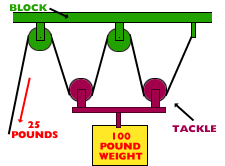
The Block & Tackle Pulley as an
Analogy of the Power of Leveraging
Concurrent Space Developments
to deliver much more to the Moon
“ in Earth orbit you are
halfway to anywhere” - Robert A. Heinlein
The “effective” cost of goods delivered to the lunar surface
depends on the amount, or lack of infrastructure along the way.
The “effective” cost of goods delivered to the lunar surface
depends on the amount, or lack of infrastructure along the way.
Archimedes invention of the pulley more than 2200 years ago is one of the most important mechanical contributions to early civilization. By realizing a predict-able mechanical advantage, the “energy cost” of moving an object from one plane, say Earth’s surface, to another, say the Moon’s surface is significantly reduced. The block and Tackle pulley multiplies the advantage.
What does this have to do with space transpor-tation in general, and with the cost of delivery of goods from Earth to the Moon in particular? We certainly are not talking about setting up a physical block and tackle system in space! Rather we want to apply the analogy above in a way that illuminates the best way for us to proceed.
In short, transporting things to the Moon without any intervening infrastructure, i.e. not cashing in any infrastructure discounts or advantages, is going to remain very expensive. The “Moon Direct” plan, if we can call it that, is the “horse blinder” choice. “We are directed to put an outpost on the Moon, not to establish infrastructure along the route.” What looks like dedication will someday reveal itself to be an outright waste of resources and opportunities. Future Lunans may even view it as criminal.
In parts of this article above, we have noted that anything taken to orbit that might be useful in setting up shop on the Moon, but left to fiery destruction as its orbit decays, could be taken to the Moon at much less expense from LEO than from Earth’s surface - if Heinlein is right, for about half the cost. And that includes a lot of material, whether usable in its current form or not. The deliberate “wasting” of the External Tank is but the most obvious and long standing forfeit of opportunity. We fully understand all the disadvantages and obstacles to reusing the ET. But they are insignificant in comparison to what could have been gained by commit-ting to the modest expense of parking them in a higher very long duration orbit until the opportunity to use them in LEO or take them to the Moon arose. As a Society, we have become addicted to favoring short-term advantages over long-term goals, and such a habit, if we don’t fight the addiction, could have us following the Romans into oblivion. Again, I understand the excuses. But excuses are just what they are.
The same holds true of anything else delivered to LEO and GEO, which when no longer useful there, could be delivered to the Moon at “half the cost.” LEO and GEO are pulleys in any future fully developed lunar transportation system. So is the Earth-Moon L1 Lagrange point and other lunar orbits. Anything delivered that far that could be used, reused, restructured, or cannibalized on the Moon will be far cheaper to deliver than an equivalent item all the way from Earth.
The Lunar side of the Block & Tackle
I remember Gordon Woodcock’s paper which sought to prove that lunar oxygen used to refuel Moon-bound cargo ships, could only reduce the cost of shipping to the Moon, but not make it profitable. Duh! What’s wrong with reducing costs? Lunar oxygen, which is abundant beyond exhaustion, can be shipped to L1 and to LEO with every returning vehicle, to partially refuel each next Moon-bound craft. LOX is thus another pulley in the system. As to LH2, which is not in large supply on the Moon, we oppose shipping that off-Moon as fuel, or even for using on the Moon as fuel, except for fuel cells in which hydrogen can be recovered. Any shipment of hydrogen off the Moon limits the size to which lunar settlements and biospheres can grow. In that perspective, such shipment and usage becomes treasonable against the Lunan Frontier.
Lunar Exports
Many people point out that the Moon has nothing of value “on Earth” except perhaps Helium-3, and maybe platinum (I am very dubious of this latter idea.) What these people are failing to understand is that the logical export partner of the Moon, is not Earth, but LEO. Anything that can be made on the Moon to fit service needs in LEO can be shipped to LEO at a 20:1 fuel cost advantage over shipment of equivalent goods up from Earth’s surface. Of course, that statement does not factor in the need to amortize the costs of developing lunar industries needed to export such items. That does not change the argument, however.
Items made of concrete, cast basalt, glass, alloys of steel, aluminum, magnesium, and titanium are candidates. Yes, there will be some specialty materials that lunar industries won’t soon be able to match. But in designing LEO installations - space stations, laboratories, factories, tourist facilities, whatever, if the design team tweaks the design to use lunar products, the cost savings will be considerable. Even dehydrated food, over 50% lunar oxygen by weight, can be shipped more cheaply to LEO than from Earth! The point is, that all these export products will help defray the cost of shipping things in LEO the rest of the way to the Moon. Another Pulley!
Not to forget GEO
GEO -- Geostationary Earth Orbit -- is long overdue for wholesale restructuring of the way the limited and invaluable slots along this orbit are assigned and utilized. With large platforms supplying power and station keeping, serviced by robotic tugs, many communications and other GEO satellites can share the same orbital slot, taken to the platform by the tug, and “plugged in.” GEO is almost saturated in our present “hunter-gatherer” level of alotting space. How will products from the Moon help?
We already understand that lunar materials can bring down the cost of solar power satellites and relays in GEO by substantial proportions. [See last month’s MMM proposal for a World Wide Orbital Grid.] These same materials can help build new and larger platforms for communications and other uses. And the tugs needed will be of use as well in LEO in maximizing reuse and salvage of items in orbit, including gathering them for transshipment to the Moon. GEO platforms, power systems and tugs -- another Pulley”
“Mechanical” Cost Advantages
Any estimate of what it will cost to open the Lunar Frontier, that neglects the opportunities to ship to the Moon anything shipped to LEO, GEO, or other points in between and no longer needed at those points, or which neglects to credit exports from the Moon to LEO, GEO, or other points between will necesarily be fantastically outlandish.
At the same time, we are not saying that opening the Lunar Frontier will quite pay for itself in the near future. That said, we are confident it will do so much more quickly than most authorities now estimate. Those less optimistic predictions are a natural, given the human tendency to be too optimistic in predicting the near-term future and far too pessimistic in predicting the long-term future.
I was asked recently to outline “The Ten Steps Needed to Create an Earth-Moon Economy.” I dislike pre-set outlines. Whether it is five steps or fifty is uncertain. But this set of articles on “Thinking outside the Mass-Fraction Box” are my first installment towards an answer to that request. In other words, we are not going to succeed in setting up an Earth-Moon economy without paying attention to “the pulley points” along the way.
LEO & GEO can
only be fully developed
using the significant cost advantage
of Lunar materials and exports.
The Moon cannot be fully developed without
access to materials and items shipped to LEO
which when they are of no further use there,
are then transshipped to the Moon.
using the significant cost advantage
of Lunar materials and exports.
The Moon cannot be fully developed without
access to materials and items shipped to LEO
which when they are of no further use there,
are then transshipped to the Moon.
The first Step: a refueling station in LEO
At the 2007 International Space Development Conference in Dallas over the Memorial Day Weekend, Dallas Bienhoff of Boeing gave a convincing presentation that simply by refueling Moon-bound craft in LEO, we could deliver 60% more goods for the money. Please view the three video segments produced by the Moon Society in which Bienhoff explains his thesis.
http://www.youtube.com/watch?v=_WxvIk463P0&feature=related
http://www.youtube.com/watch?v=m6H9G0eh1vc&feature=player_embedded
http://www.youtube.com/watch?v=N-cFfPUjKpU&feature=related
Bienhoff is correct in saying that NASA has an obligation to identify the least expensive way back to the Moon. However, that constraint imposed by Congress, is shortsighted, in words we all know, “pennywise and pound foolish.” The current Spartan approach can only be defended if setting up a lunar outpost is a goal in its own, without considering further use of that outpost, or further lunar developments.
Many years ago, I wrote in an In Focus editorial which I can’t locate at the moment, that the space enthusiast community has all too often attempted to sell the ladder of our dream one rung at a time. When we do that, the rung in question gets designed as a be-all and end-all in itself, not as a rung leading to the next rung, not as part of the ladder. Thus we have only ourselves to blame for the Space Station becoming a black hole for funding, leading nowhere. In the selling of the Station, it became not a depot to outer space as conceived of by Wernher von Braun, but a downward looking Earth-research laboratory, the pride of “yo-yo space.” We were afraid that if we talked about our real dream, no one would listen. The result of this space enthusiast consensus strategy of the early eighties is 20-some years since of going nowhere.
If we promote the NASA permanent, but not permanently occupied, science outpost as a goal in itself, that’s what it will become. Because we can’t allow ourselves as a nation to look further down the road, we will continue to make stupid shortsighted decisions which will only bring further delays to opening the Moon.
Anything that is worth doing is worth doing right. We have to rethink the NASA moonbase as a rung in a ladder, that means flushing LAT-2 down the LATrine. It’s a quite brilliant design intended to lead to nowhere.
Ten Steps to an Earth-Moon Economy? It includes building up a block-&-tackle-reminiscent set of cost savings enhancers in LEO, GEO, L1, and on the Moon itself. And it includes dumping LAT-2 constraints. NASA has rightfully canceled further biological life support system research as not of use for its current concept of the lunar outpost. Can there be any more eloquent clue that the agency is off track, way off on a tangent?
NASA itself admits the potential for using lunar resources, but has chosen for this Congressional assignment to constrict its vision to what is pertinent for the mission so defined. In its dedication, NASA has unwittingly chosen to become part of the problem. Yet the agency has enormous expertise and problem solving resources. It needs a change in direction that unleashes those talents. Perhaps the next administration will see to that. In the Apollo program, NASA was at its prime. Under present leadership, the agency is playing a caricature role, expertly. But this is the price we pay for a space program that continues to be a political football.
We, those of us in the bleachers, disparaged by NASA and the government alike, have to be vigilant for ways to make an end run around what is happening. The LEO and GEO and even Lunar export options we have mentioned will be the work of private enterprise. That’s our point of entry. Optimism has to be earned. <MMM>